
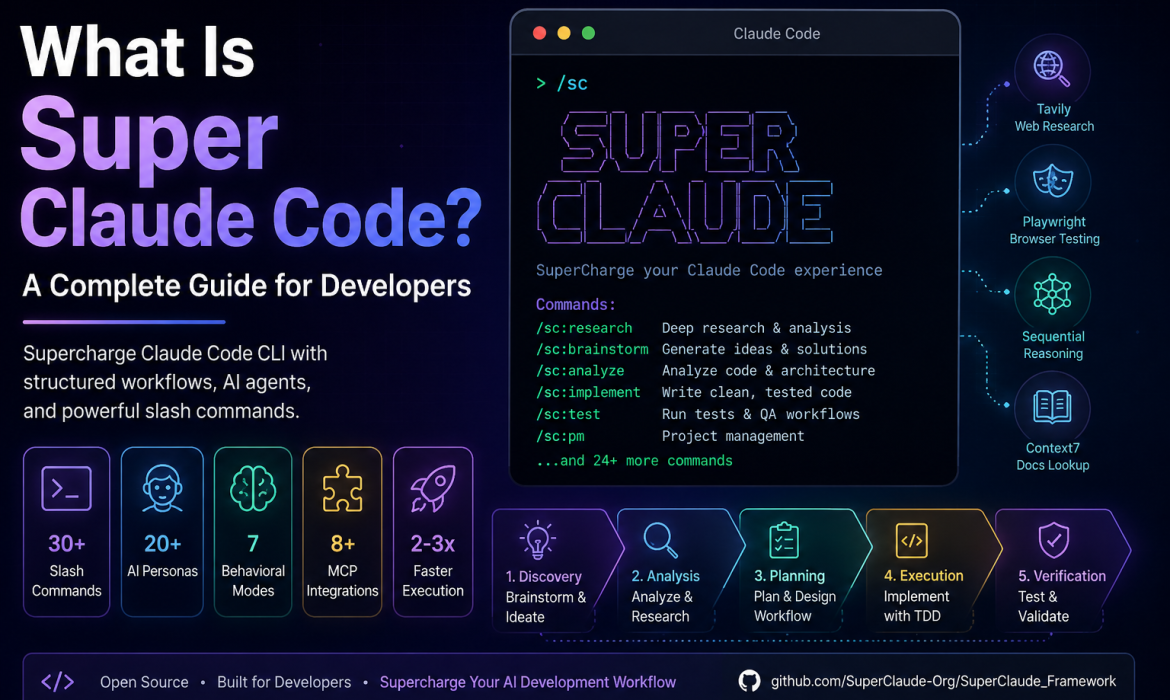
Artificial intelligence has transformed software development. Code generation, debugging, documentation, testing, and project planning are now being completed with the assistance of AI-powered tools. Yet, one major problem continues to be observed. Large language models often generate code immediately without spending enough time on architecture, planning, validation, and testing.
This challenge has been addressed by Super Claude Code, an open-source framework designed to enhance the capabilities of Anthropic’s Claude Code command-line interface.
Instead of allowing development tasks to be completed in an unstructured manner, a professional engineering workflow is enforced through predefined commands, specialized AI personas, behavioral modes, and integrated research tools.
For development teams, startup founders, and agencies such as Rochak Enterprise, this framework can be viewed as a productivity layer that transforms AI-assisted coding into a systematic development process.
Information used in this article has been derived from the official documentation and installation guides provided by the project maintainers.
What Is Super Claude Code?
Super Claude Code is an open-source meta-programming and configuration framework that extends the functionality of Claude Code.
Additional commands, AI agents, workflow automation, and research capabilities are injected into the terminal environment. As a result, software development can be approached through a structured methodology instead of relying on spontaneous AI responses.
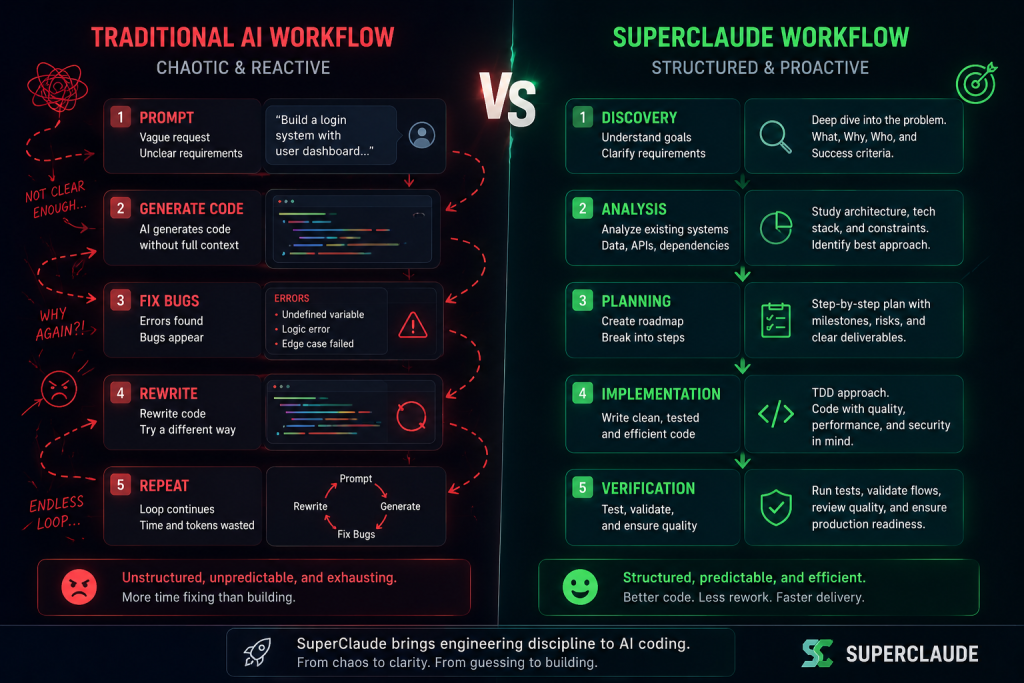
Traditional AI coding often follows this pattern:
- Prompt
- Code generation
- Bug fixing
- More prompting
- Repeated revisions
A different workflow is introduced by the framework:
- Discovery
- Analysis
- Planning
- Implementation
- Verification
By forcing each phase to be completed systematically, software quality can be improved while development mistakes can be reduced.
Why Was Super Claude Created?
Many developers have discovered that AI-generated code frequently introduces several challenges:
- Poor architecture
- Missing documentation
- Inconsistent testing
- Weak security reviews
- Unclear requirements
The framework was developed to solve these problems by introducing predefined engineering standards and repeatable workflows.
Instead of asking an AI assistant to “build an application,” developers are encouraged to break the project into smaller phases.
Requirements are clarified first.
Architecture is analyzed second.
Implementation is planned third.
Coding is completed fourth.
Testing is performed last.
Human beings have somehow managed to turn software development into a process involving 47 browser tabs, three unfinished Git branches, and one AI conversation containing 900 messages. A framework that introduces order was probably inevitable.
Key Features of Super Claude Code
1. More Than 30 Slash Commands
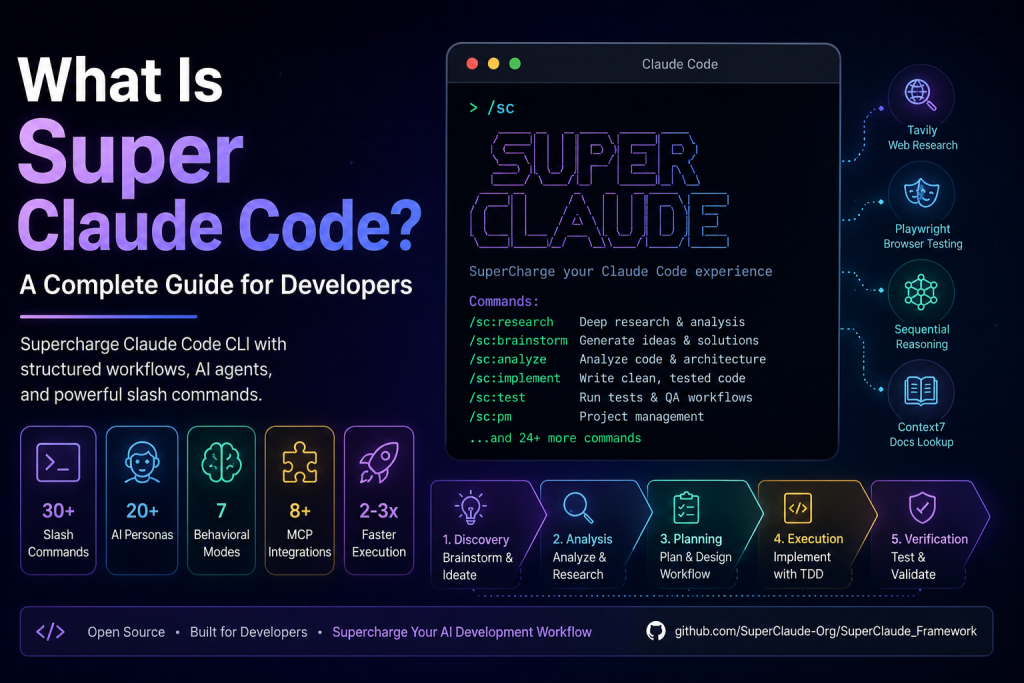
One of the biggest advantages of the framework is its command library.
More than 30 specialized commands are provided to simplify common development tasks. Documentation confirms that all commands can be installed directly into Claude Code.
Some popular commands include:
| Command | Purpose |
|---|---|
/sc:research | Performs deep research |
/sc:brainstorm | Generates ideas and requirements |
/sc:analyze | Reviews codebases and architecture |
/sc:implement | Generates production code |
/sc:test | Executes testing workflows |
/sc:pm | Supports project management |
/sc | Displays all available commands |
Examples of officially documented commands can be found in the project documentation.
2. Twenty Specialized AI Agents
Instead of using a single generalized AI assistant, developers are provided with specialized agents.
According to the official release notes, 20 expert agents are included within the framework.
Examples include:
- Software architects
- Frontend architects
- Security engineers
- Research agents
- Project managers
- Testing specialists
Each agent is designed to focus on a specific discipline.
For example, a security engineer can be activated to identify vulnerabilities, while a frontend architect can be used to analyze interface patterns.
3. Seven Behavioral Modes
Behavioral modes change how problems are approached.
Seven adaptive modes are currently available. These modes were introduced to support different development scenarios.
Available modes include:
- Brainstorming
- Business analysis
- Deep research
- Orchestration
- Token efficiency
- Task management
- Introspection
Instead of receiving identical responses for every prompt, developers can switch the AI into a specific thinking pattern.
4. MCP Server Integrations
One of the most powerful features of the framework is its support for MCP servers.
Eight server integrations are officially documented. These integrations expand the framework beyond simple code generation.
Supported integrations include:
| MCP Server | Function |
|---|---|
| Tavily | Web research |
| Context7 | Documentation lookup |
| Sequential-Thinking | Multi-step reasoning |
| Serena | Memory and session persistence |
| Playwright | Browser automation |
| Magic | UI generation |
| Morphllm-Fast-Apply | Context-aware modifications |
| Chrome DevTools | Performance analysis |
The Five-Phase Development Workflow
The framework organizes software development into five distinct stages.
Discovery
The discovery phase focuses on idea generation and requirement gathering.
Example command:
/sc:brainstorm
Analysis
During analysis, repositories, databases, APIs, and dependencies are examined.
Example command:
/sc:analyze
Planning
An implementation roadmap is generated before coding begins.
Example command:
/sc:workflow
Execution
Code is generated during the execution phase.
Example command:
/sc:implement
Verification
Testing and quality assurance are completed during the final stage.
Example command:
/sc:test
This workflow encourages engineering discipline rather than encouraging AI-assisted improvisation.
How to Install Super Claude Code
Installation can be completed through Python’s package manager.
Step 1: Install the Framework
pipx install superclaude
Step 2: Install All Commands
superclaude install
Step 3: Install Optional MCP Servers
superclaude mcp --list
Install a specific server:
superclaude mcp --servers tavily --servers context7
Step 4: Verify the Installation
superclaude install --list
superclaude doctor
These installation commands are documented in the official setup guide.
Performance Improvements With MCP Servers
Official documentation suggests that optional MCP integrations can significantly improve performance.
According to the project documentation:
- Execution can become 2 to 3 times faster.
- Token usage can be reduced by 30% to 50%.
These improvements are achieved through specialized tools such as Tavily, Sequential, and Context7.
How Rochak Enterprise Can Use This Framework
At Rochak Enterprise, services such as custom software development, AI automation, website development, and application development can benefit from a structured AI workflow.
Potential use cases include:
- WordPress plugin development
- SEO automation
- AI-powered content systems
- Desktop application development
- Custom CRM development
- POS software development
- Browser automation testing
- Documentation generation
Development agencies often lose time because requirements are discussed after coding has already started. The framework attempts to reverse that habit by forcing planning to be completed first. Software engineers have spent decades trying to convince clients that requirements should be written before development begins. The framework simply decided to automate that argument.
Is Super Claude Code Worth Using?
The answer depends on the complexity of the project.
For small scripts, the framework may feel unnecessary.
For larger projects involving multiple files, APIs, databases, testing pipelines, browser automation, and documentation, significant advantages can be gained.
The framework is particularly useful for:
- Software agencies
- Startup founders
- AI developers
- Full-stack engineers
- DevOps teams
- Technical consultants
Final Thoughts
AI-assisted programming is evolving rapidly. Simple prompting is gradually being replaced by structured development systems.
The framework demonstrates that better software can be produced when architecture, planning, implementation, and testing are treated as separate stages rather than being compressed into a single AI conversation.
Developers searching for a more disciplined approach to Claude Code may find that this framework provides exactly that.
After all, letting an AI write thousands of lines of code without a plan has always been a fascinating experiment. Humans called it innovation. Debugging sessions called it something else.